
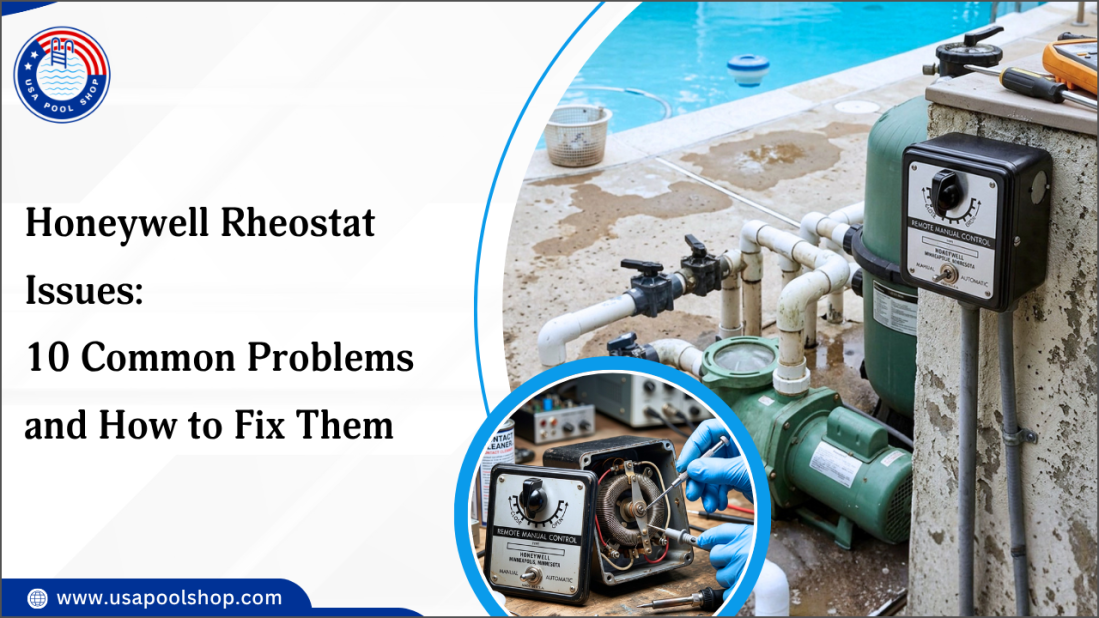
A Honeywell rheostat is a manual control component used in compatible motor and control systems to adjust or position equipment. In pool and spa environments, rheostat-related issues can affect equipment that relies on motorized controls, actuators, valves, dampers, or other adjustable components. Honeywell describes its remote manual potentiometers as controls for Series 90 Modutrol motors, where the resistance signal is used to position the connected motor.
When a rheostat develops a problem, the symptoms can range from inconsistent adjustment and intermittent operation to a connected motor that does not respond at all. However, a rheostat is only one part of the control circuit. Loose wiring, moisture, damaged terminals, motor problems, or mechanical restrictions can produce similar symptoms.
For pool owners and technicians, understanding these differences makes troubleshooting easier and helps avoid replacing a good control unnecessarily.
In this guide, we'll cover the 10 most common Honeywell rheostat problems, explain what each symptom indicates, identify the likely causes, and show how to troubleshoot and fix rheostat-related problems in pool equipment.
What Does a Honeywell Rheostat Do in Pool Equipment?
A rheostat or manual potentiometer provides adjustable electrical resistance that can be used to control or position compatible motorized equipment. Honeywell's documentation describes remote manual potentiometers as controls for Series 90 Modutrol motors, allowing manual adjustment of the connected motor from an accessible location.
In pool-related equipment, this type of control can be relevant wherever a compatible motorized control system is used. It should not be assumed that a rheostat is a universal variable-speed pool pump controller. Its actual function depends on the equipment and control circuit in which it is installed.
Before troubleshooting a Honeywell rheostat, understand its main functions:
Provides manual adjustment: The control allows an operator to change the resistance signal manually.
Controls compatible motor positioning: The resistance signal can influence the position of a compatible motor or actuator.
Provides accessible equipment control: Remote controls can be installed where an operator can conveniently adjust the connected equipment.
Works as part of a larger control circuit: The rheostat depends on wiring, power, connected motors, and other control components.
Allows repeatable adjustment: A properly functioning control should provide a predictable response across its operating range.
For pool and spa applications, the most important point is that a rheostat should be diagnosed as part of the pool equipment control system. If the connected motor does not respond, the rheostat may not necessarily be the failed component.
Shop atUSAPoolShop for quality Honeywell rheostats and pool equipment replacement parts designed to support reliable equipment control and performance. Explore Honeywell control components, rheostats, electrical parts, motor controls, and other replacement components that help maintain proper operation, simplify repairs, and keep your pool and spa equipment running efficiently.
10 Common Honeywell Rheostat Problems and How to Fix Them
A Honeywell rheostat can develop electrical, mechanical, or connection-related problems over time. Some symptoms point directly toward the control, while others indicate that the connected motor or control circuit needs inspection.
The table below highlights the most common Honeywell rheostat problems, what they indicate, why they happen, and the appropriate solution.
Problem | What It Indicates | Why It Happens | How to Fix It |
Rheostat does not respond when turned. | The connected pool equipment does not react to manual adjustment. | Loss of power, loose wiring, internal wear, or a control-circuit problem. | Check power, wiring, terminals, and rheostat operation before replacing it. |
The rheostat works only at certain positions | Part of the adjustment range may be ineffective. | Internal wear or damaged electrical contacts can create dead spots. | Test the resistance response across the operating range and replace the control if defective. |
Pool equipment responds intermittently. | The control signal is inconsistent. | Loose terminals, corrosion, worn contacts, or damaged wiring can interrupt the signal. | Inspect connections and wiring and test the rheostat under the equipment specifications. |
The connected motor does not move. | The rheostat may be working while the motor or actuator has another problem. | Motor failure, wiring faults, mechanical binding, or insufficient power. | Test the motor and control circuit before replacing the rheostat. |
Equipment moves in the wrong direction. | The control signal or wiring configuration may be incorrect. | Incorrect terminal connections or a control-system wiring problem. | Disconnect power and verify the wiring against the equipment documentation. |
The rheostat feels loose or difficult to turn. | The mechanical control may be worn or damaged. | Physical impact, mounting problems, shaft damage, or internal wear. | Inspect the mounting and control mechanism; replace it if damaged. |
The rheostat produces inconsistent equipment positioning. | The resistance signal may not change smoothly. | Internal wear, poor connections, or incompatible components. | Check resistance across the adjustment range and inspect the complete control circuit. |
The rheostat becomes unusually warm. | An electrical or application problem may exist. | Excessive electrical load, incorrect wiring, or an unsuitable control application. | Shut down the equipment and have the circuit inspected before continuing operation. |
The rheostat stops working after moisture exposure. | Electrical connections or internal components may be compromised. | Condensation, water exposure, or corrosion can affect electrical contacts. | Disconnect power and inspect the control, enclosure, terminals, and wiring. |
The replacement rheostat does not work correctly. | The replacement may not match the original control application. | Incorrect resistance value, wiring arrangement, or incompatible equipment. | Verify compatibility and the manufacturer's specifications before installation. |
Honeywell's documentation confirms that its remote manual potentiometers are designed for specific motor-control applications rather than universal motor-speed control.
This distinction is especially important when troubleshooting pool equipment. If a motor does not respond when the rheostat is adjusted, test the motor, wiring, and power supply before assuming the rheostat has failed.
What Causes Honeywell Rheostat Problems?
Several conditions can cause a Honeywell rheostat to perform inconsistently. In pool environments, electrical controls can also face additional exposure to humidity and condensation.
Normal Wear of the Internal Resistance Element
A rheostat or potentiometer relies on an adjustable electrical resistance path. Repeated movement can eventually wear the internal contact surface.
One common symptom is a control that works normally in some positions but produces little or no response in others.
If the control has developed dead spots, inconsistent resistance, or erratic output, electrical testing can determine whether the internal component is still operating correctly.
Loose or Corroded Wiring Connections
Loose terminals can interrupt the control signal between the rheostat and the connected motor or actuator.
Pool equipment rooms can also have higher humidity than ordinary indoor environments. Corrosion around terminals can increase resistance or cause intermittent connections.
Inspect connections for:
Loose terminals
Corrosion
Damaged wires
Broken insulation
Disconnected conductors
Signs of moisture
A wiring problem should be corrected before replacing the rheostat.
Moisture and Condensation
Electrical controls located around pools and spas can be exposed to moisture even when they are not directly splashed with water.
Condensation can accumulate inside an enclosure or around terminals. Over time, moisture can contribute to corrosion and electrical instability.
If a rheostat suddenly stops working after water exposure or significant condensation, inspect the surrounding control enclosure rather than immediately installing a replacement.
Incorrect Wiring
A rheostat must be wired according to the control system in which it is installed. Incorrect terminal connections can cause no response, erratic movement, or incorrect equipment operation.
This is especially important when replacing an older control. Photographing the existing wiring before removal and comparing the installation with the equipment documentation can help prevent wiring errors.
Incompatible Control Application
Not every rheostat can be used with every motor or pool control system.
Honeywell identifies its remote manual potentiometers for specific Series 90 motor applications.
Therefore, a replacement should match the resistance requirements and control configuration of the equipment.
Installing a control simply because the physical appearance is similar can result in incorrect operation.
Connected Motor or Actuator Failure
A rheostat can function correctly while the connected motor remains stationary.
If changing the rheostat setting produces the expected control signal but the motor does not move, the problem may be the motor, actuator, relay, power supply, linkage, or another component.
This is why replacing the rheostat should generally be the result of diagnosis rather than the first troubleshooting step.
Mechanical Binding
If the connected pool equipment uses a motorized valve, actuator, damper, or similar mechanical component, physical resistance can prevent movement.
A rheostat may appear to be ineffective when the actual problem is a seized or restricted mechanical component.
How to Troubleshoot a Honeywell Rheostat Problem
If a Honeywell rheostat is not controlling compatible pool equipment correctly, follow a systematic diagnostic process. Electrical controls should be serviced only after power has been safely disconnected and appropriate safety procedures have been followed.
Identify the exact symptom: Determine whether the problem is no response, intermittent operation, limited adjustment, incorrect movement, or complete motor failure.
Check the equipment power supply: Confirm that the connected control system and motor are receiving the required power.
Inspect the rheostat: Look for physical damage, loose mounting, unusual resistance when turning, or signs of moisture.
Inspect wiring and terminals: Check for loose, corroded, disconnected, or damaged connections.
Verify the control configuration: Confirm that the rheostat is appropriate for the connected motor and control system.
Check the connected motor: If the rheostat operates but the motor does not respond, inspect the motor and actuator separately.
Inspect mechanical components: Look for binding valves, linkages, dampers, or other components that could prevent movement.
Test the resistance: A qualified technician can measure resistance through the rheostat and compare the result with the applicable equipment specifications.
Check the entire control circuit: A failed relay, controller, transformer, or wiring connection can mimic a rheostat failure.
Replace the control only after testing: If the rheostat fails electrical or mechanical inspection, replace it with a compatible component.
Honeywell's control documentation shows that manual potentiometers are used as part of larger motor-control arrangements, reinforcing the importance of diagnosing the complete circuit rather than treating the rheostat as an isolated component.
For pool equipment, this approach can prevent unnecessary replacement of otherwise functional pool motor controls and help identify the actual source of the problem.
Summary: How to Prevent Honeywell Rheostat Problems
A Honeywell rheostat can provide reliable manual adjustment when it is correctly matched to the motor and control system. However, problems can develop from internal wear, wiring faults, moisture, incorrect installation, mechanical restrictions, or failures elsewhere in the control circuit.
Key Takeaways
Inspect the rheostat when pool equipment does not respond correctly to manual adjustment.
Do not assume every motor-control problem is caused by the rheostat.
Check wiring, terminals, power supply, and connected motors before replacing the control.
Look for corrosion or moisture around electrical connections.
Replace controls that have damaged adjustment mechanisms or inconsistent electrical performance.
Verify compatibility before installing a replacement rheostat.
Inspect connected valves, actuators, linkages, and other mechanical components for binding.
Use the manufacturer's specifications when testing resistance and control operation.
Keep electrical controls protected from water and excessive moisture.
Have qualified professionals perform electrical testing when the circuit cannot be safely diagnosed through visual inspection.
Routine inspection of pool equipment controls can help identify rheostat problems before they cause prolonged equipment downtime. When the control, wiring, motor, and mechanical components are checked together, troubleshooting becomes more accurate and replacement decisions become easier.
FAQs
Why does my pool equipment respond intermittently to the rheostat?
Intermittent operation can be caused by worn internal contacts, loose terminals, corrosion, damaged wiring, moisture, or a problem elsewhere in the control circuit. Inspect the complete system rather than replacing the rheostat immediately.
Can moisture damage a Honeywell rheostat?
Yes. Moisture and condensation can contribute to corrosion and electrical problems around control components. If a rheostat has been exposed to water, disconnect power and inspect the control and surrounding wiring before putting the equipment back into operation.
Why does the motor not move when I turn the rheostat?
The problem may be the motor rather than the rheostat. A failed motor, insufficient power, damaged wiring, faulty relay, or mechanical binding can all prevent movement. The control signal and motor should be tested separately.
Can I use any Honeywell rheostat for pool equipment?
No. Rheostats and potentiometers are designed for specific electrical and control applications. Honeywell identifies its remote manual potentiometers for compatible Series 90 motor-control applications, so the control requirements of the pool equipment should be verified before installation.
Why does my rheostat feel difficult to turn?
A difficult-to-turn control can have a damaged or worn mechanical mechanism, mounting issue, or internal problem. Do not force the knob because excessive force can damage the control further.
Disclaimer: This guide is for general informational purposes only. Always disconnect power and follow manufacturer specifications. |



Validate your login